
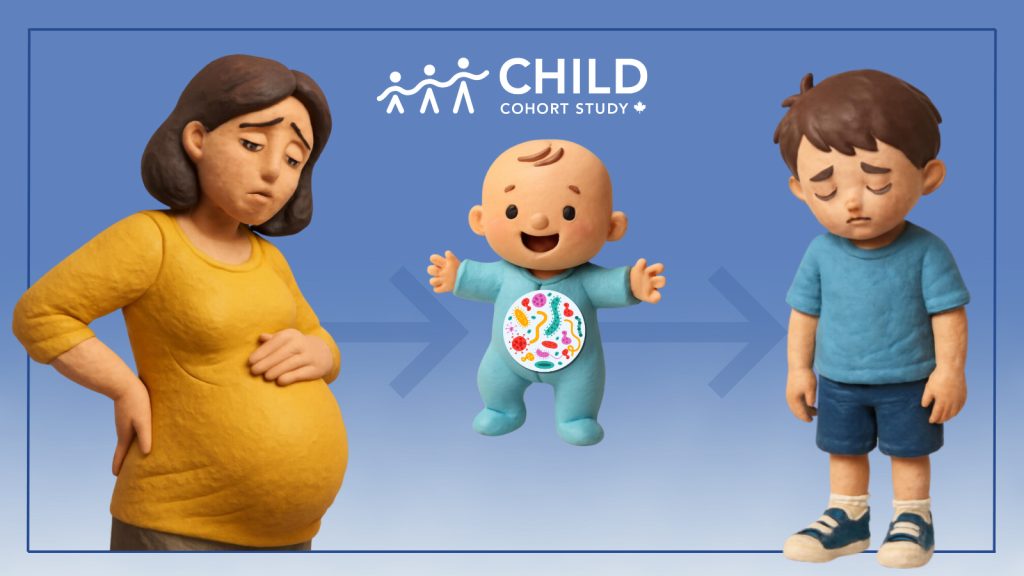
New findings suggest that a mother’s stress during pregnancy may affect how her baby’s gut microbiome develops in the first year of life. In turn, this may influence the child’s later risk for anxiety and depression.
This study was conducted in the UBC Depression, Anxiety, and Stress Laboratory (Principal Investigator: Dr. Joelle LeMoult) and the UBC Finlay Lab (Principal Investigator: Dr. Brett Finlay), using data from the CHILD Cohort Study (CHILD); co-author Dr. Stuart Turvey is co-director of CHILD.
The microbiome—the community of bacteria, fungi and other microbes that live in and on our bodies—plays a crucial role in our development by impacting immune, metabolic, and brain development early in life.
In this study, researchers used data from nearly 3,000 families enrolled in CHILD. They examined whether pregnant individuals’ perceived stress in the third trimester was associated with their child’s gut microbiota composition at 3 and 12 months, and subsequent emotional wellbeing at age 5.
In a paper published in Brain Behaviour and Immunity, the researchers report that when mothers experienced higher stress during pregnancy, their babies experienced a faster pattern of gut microbiome development in early infancy.
As the authors observe, the microbiota begins developing, or maturing, at birth, with new bacteria slowly incorporated across the first year. This process appears to be tightly regulated by nature, with similar maturation patterns observed in babies from different parts of the world. Evidence suggests that the pace of maturation is just as important as the microbes that make up the community itself.
“In this study we found that at 3 months, babies whose mothers reported more stress during pregnancy had higher gut microbial diversity, or more bacteria already colonizing them, compared to infants whose mothers did not report high levels of stress during pregnancy,” says lead author Dr. Ellen Jopling of Harvard Medical School.
“This suggests that their microbiome was maturing faster than expected.”
Infant microbiomes that matured early introduced fewer new bacteria over time, indicating a ‘flattened’ developmental trajectory: rapid early development followed by a long stable period with little change. This flattened development was associated with later mental health outcomes. Both higher diversity at 3 months and reduced change in diversity from 3 to 12 months were linked to higher symptoms of anxiety and depression at 5 years of age.
“By linking prenatal stress, early microbiome development, and later child mental health, this work highlights pregnancy as a critical window to support children’s later emotional health, ” comments co-author Dr. Avril Metcalfe-Roach of the University of British Columbia.
“Future efforts could build on this finding; for example, through the promotion of policies that reduce stress in pregnancy, or through targeted biological interventions that support healthy microbiome development in at-risk infants,” notes Dr. Jopling.