
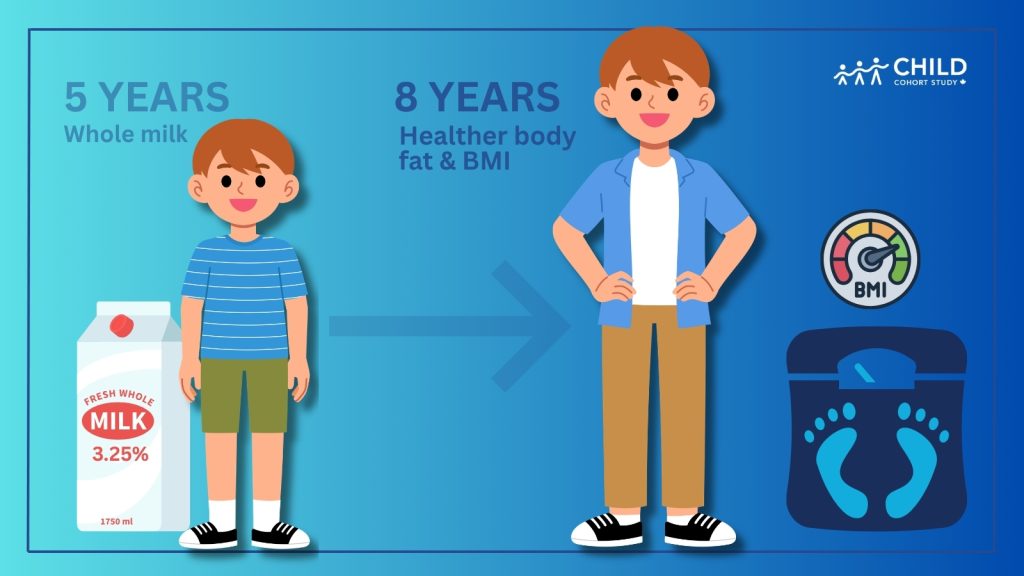
New research from CHILD has found that children who drink whole cow’s milk at age five tend to have lower levels of body fat and less risk of obesity by age eight, compared to children who consume no fat or skim-fat milk.
Published in The American Journal of Clinical Nutrition, this finding adds to a growing body of evidence challenging the common recommendation that young children should consume reduced-fat or skim milk to prevent obesity.
The researchers analyzed the data from over 1500 participants in CHILD. When participants were 5 and 8 years old, their parents or caregivers reported on their dietary intake, including the fat content of the milk they consumed, and CHILD researchers took various physical measurements of the children, including standard measurements for body fat and obesity.
An analysis of the resulting data showed that at age 5, almost 50% of the children consumed 2% milk and almost 24% consumed 3.25% milk. It also found that consuming whole milk, in comparison with skimmed milk, was associated with lower body-mass-index (BMI) z-scores among these kids at age 5, and with overall lower obesity and adiposity indicators at age 8.
“Childhood obesity is a pressing public health issue,” observe lead authors Dr Tara Zeitoun and Zheng Hao Chen, trainees at Miliku lab: “Early excess adiposity often carries over into adulthood and contributes to an increased risk of heart disease, diabetes, and other chronic conditions.”
“We should use every available opportunity to prevent the beginnings of obesity in early life. This study points to a simple preventative step that can be easily taken.”
As to why consuming whole milk is associated with lower obesity risk, the researchers say the exact mechanism is unknown but there are various potential explanations. Among them, the fact that milk fat may interact with hormones to create a sense of satiety (feeling full), and that the combined components of milk, including fat, may produce unique metabolic effects that similarly influence satiety and energy balance.
Whatever the mechanism, their findings indicate that even small differences in milk fat consumption in early childhood may carry measurable implications for people’s adiposity (or body fat) trajectories.
Current North American guidelines generally recommend transitioning children to reduced-fat milk after age two to limit saturated fat intake.
“Our findings suggest that recommendations around milk fat in early childhood may warrant continued evaluation using child-specific longitudinal data,” said senior author Dr. Kozeta Miliku, Assistant Professor of Nutritional Sciences at the University of Toronto and Clinical Science Officer of the CHILD Cohort Study.
“Guidelines have historically relied heavily on adult evidence. As more pediatric data emerge, it’s important that policies reflect what we observe in children.”
The researchers emphasize that further randomized and mechanistic studies are needed to determine causality and clarify optimal recommendations.