
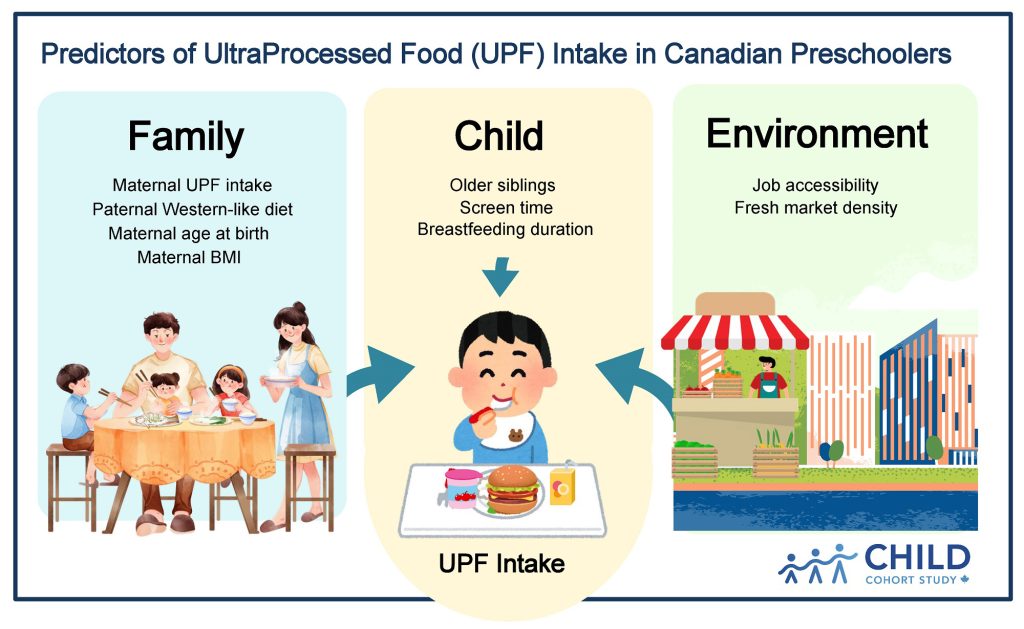
New CHILD research provides insight into why some children consume more ultraprocessed foods than others. The research, published in Nature: Communications Medicine, found that characteristics of a child’s family and their built environment both play a role. Given that higher consumption of these foods is associated with poorer health outcomes, these findings point to possible policy approaches toward improving children’s health through their diets.
Ultraprocessed foods are characterized by high levels of added sugars, sodium, saturated fats, and additives. Unlike whole foods or minimally processed foods, they are typically manufactured using ingredients not commonly used in home cooking and undergo series of industrial processes that change their basic nutritional value.
“In Canada, nearly half of children’s daily energy intake is derived from ultraprocessed foods,” comments lead author Sara Mousavi, a former undergraduate student in the Miliku lab at the University of Toronto.
“This is very concerning , because higher consumption of these foods has been associated with poorer physical and mental health in children and adolescents.”
“In this study, we sought to understand why some children consume more ultraprocessed foods than others, in the hope that we might identify factors that could be changed to give these children a better start.”
Using data from over 2,400 CHILD participants, collected between birth and three years of age, the researchers examined how family habits and neighbourhood environments together shape children’s ultraprocessed food intake. They found that children ate more ultraprocessed foods when their parents consumed more of these foods, when they had older siblings, when screen time was higher, and when families lived in areas with limited access to fresh food markets or longer travel times to work.
Children who were breastfed longer as infants, on the other hand, tended to consume fewer ultraprocessed foods at age three. On average, the researchers found that ultraprocessed foods contributed 45% of total daily energy intake among these children at three years of age.
“Altogether, these findings show that early-life diet is shaped by both family and the environment children grow up in,” states senior author Dr. Kozeta Miliku, Assistant Professor in the Department of Nutritional Sciences at the University of Toronto and Clinical Science Officer for CHILD.
“Effective policies must therefore go beyond individual choices to improve food environments and support healthy childhood development.”
“It also bears noting that, within these patterns of ultraprocessed food consumption, an equity dimension may be at play,” adds co-author Zheng Hao Chen, a trainee in Dr. Miliku’s lab.
“Some of the factors contributing to higher ultraprocessed food intake, such as living further from jobs or having more than one child at home, suggest families with busy lifestyles and fewer resources may opt for ultraprocessed foods because of their convenience and affordability. These families may face disproportionate barriers and could benefit most from structural policy changes, including changes that promote more equitable urban design to enabling healthy eating.”
Read the editorial about this research
Read about other CHILD research on ultraprocessed foods:
CHILD Clinical Research Officer Dr. Kozeta Miliku offers advice on reducing UPF consumption