Below, Hugo and Ryan answer some questions about C.L.E.A.R.
Tell us a bit about your project.
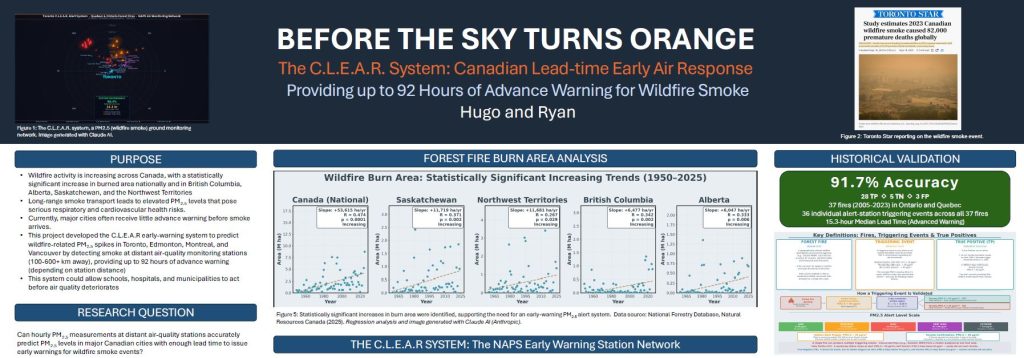
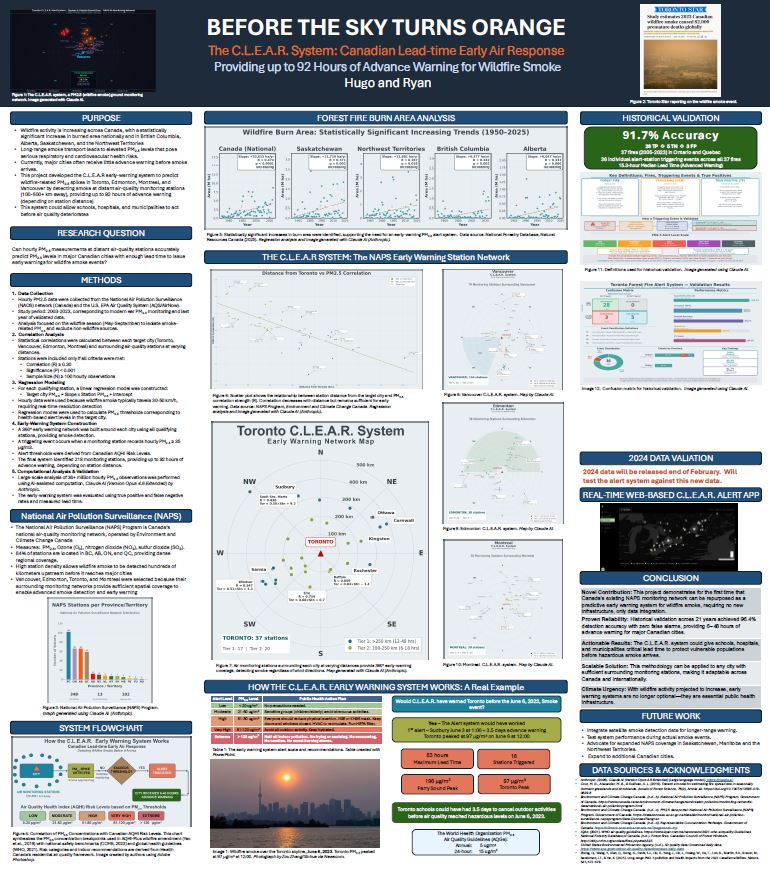
Our project is basically an early warning system for wildfire smoke. Wildfire activity is increasing in Canada, producing hazardous PM2.5 microparticles that can threaten the public.
Back in the summer of 2023, the smoke got so bad that the sky over Toronto actually turned orange, and we noticed that by the time anyone warned people, the bad air was already there. We thought there had to be a better way to see it coming ahead of time.
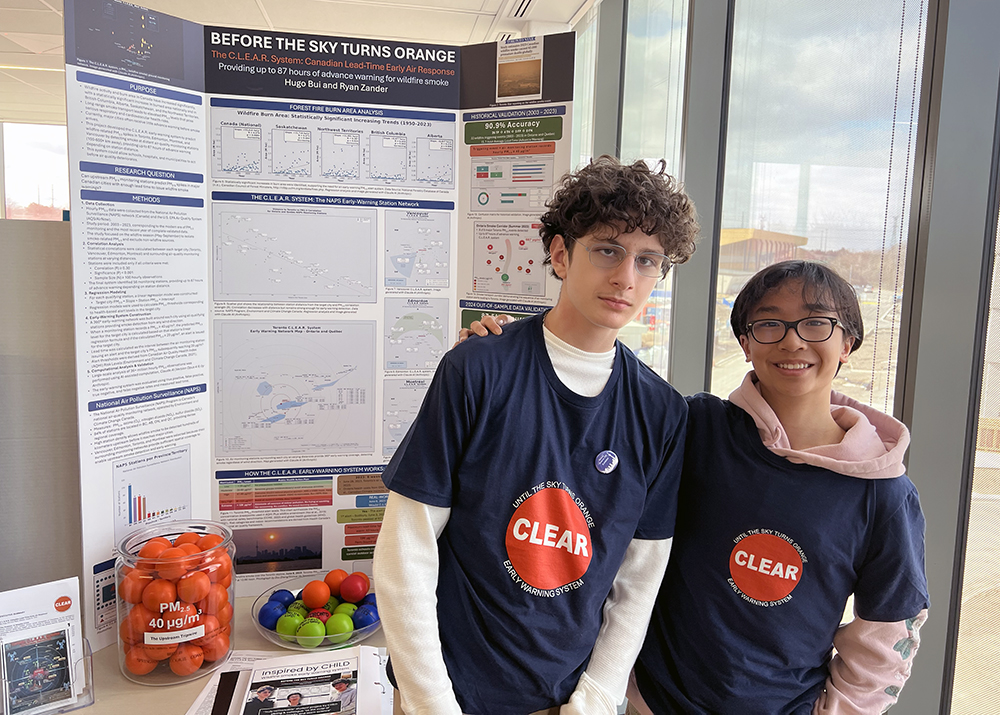
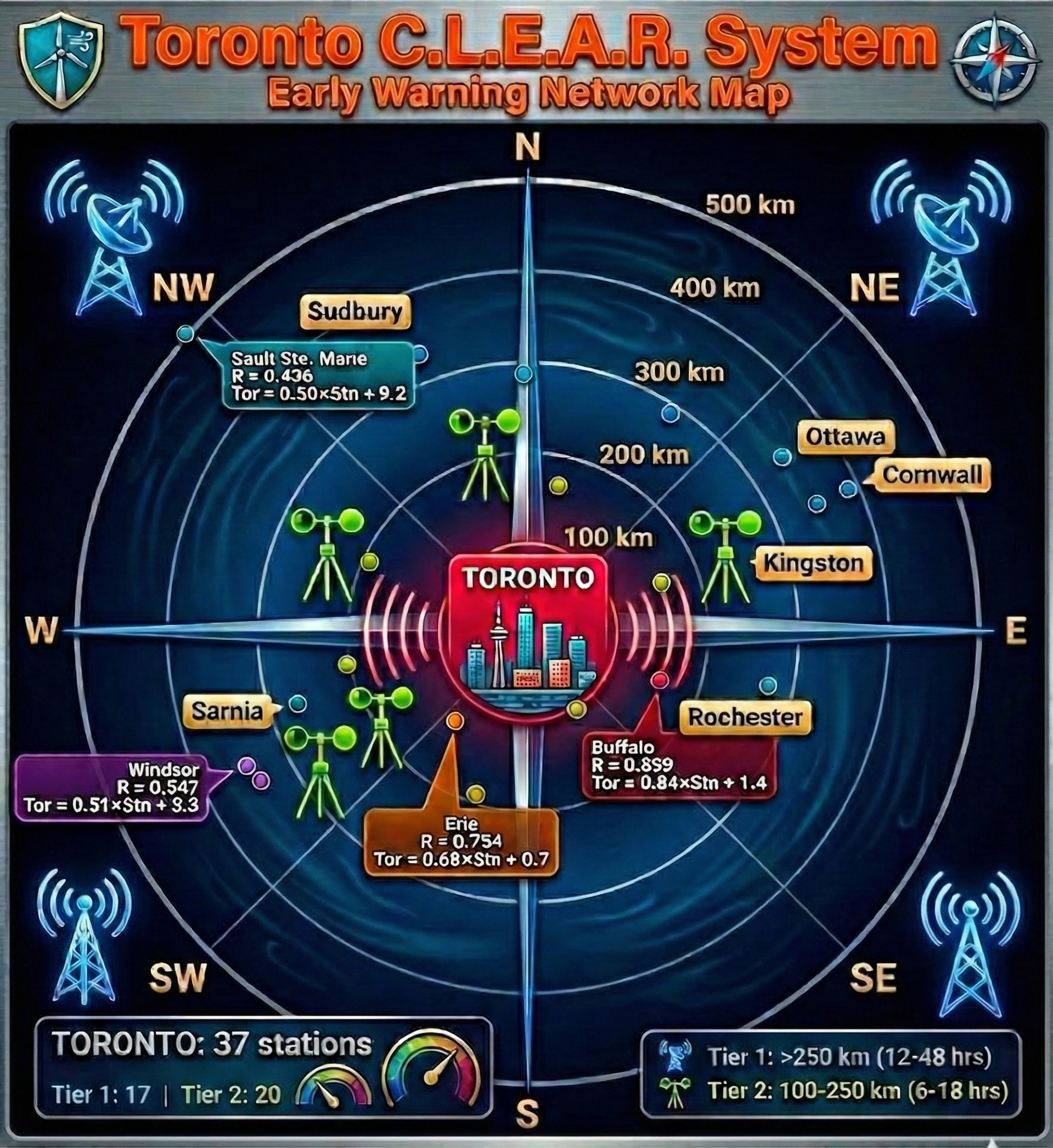
Our novel ground monitoring network uses National Air Pollution Surveillance (NAPS) stations and 36 million data points to predict wildfire smoke in Toronto and other major Canadian cities. By detecting smoke hundreds of kilometres upstream, the system enables schools, hospitals, and municipalities to act before exposure peaks.
Why did you choose this specific topic?
Growing up watching my brother Russell participate in CHILD made me pay attention to how much the environment affects our lungs. I already knew that PM2.5, the tiny particles in wildfire smoke, is really bad for kids, especially those with asthma. So Ryan and I wondered: what if we could actually give families a heads up before it hits?
How does the C.L.E.A.R. system work?
The cool thing is the government already has all these air quality sensors set up across the country, and we just used them in a different way. We went through over 36 million data points from Canada’s NAPS network going back to 2003. What we found is that if you watch monitoring stations that are hundreds of kilometres away, you can basically see the smoke coming before it reaches your city—kind of like using them as radar.
What did you discover?
It actually works, which was exciting. For four major cities (Toronto, Vancouver, Edmonton, and Montreal), we were able to select specific “upstream” stations that can predict dangerous smoke events ahead of time. We also figured out how to filter out normal city pollution so the system only picks up on the big smoke events coming from far away.
When we tested it on 20 years of historical data, it was over 90% accurate. And it gives an average warning of about 16 hours ahead of time, sometimes up to 82 hours. We also further validated our model using the recently released 2024 Ontario and Quebec NAPS PM2.5 data set.
What is your ultimate goal for this research?
We want schools, families, and hospitals to have enough time to actually do something before the air gets dangerous. If they know 82 hours in advance, hospitals can get ready, and families can close their windows, turn on air purifiers, and skip outdoor plans—instead of finding out when it’s already too late.
Was there any specific CHILD research that influenced you?
Dr. Subbarao’s research on pollution and pediatric asthma initially inspired our health mission to protect vulnerable kids like my brother.
Eventually, to build our model, Dr. Jeff Brook was the exact technical expert we needed. We were aware of his pioneering AirSENCE micro-sensors and the 2015 Pan Am Games network he set up focused on high-precision, localized, real-time monitoring. Our C.L.E.A.R. system is complementary to his work by predicting wildfire smoke and providing early warnings before the air becomes dangerous. Dr. Brook was very helpful in validating our approach of using the NAPS network to predict bad smoke events.
We’re really grateful to Drs. Subbarao and Brook, as well as to Dr. Theo Moraes (Site Leader for CHILD in Toronto), for taking the time to look over our work and encourage us. It means a lot.
What is next for you both?
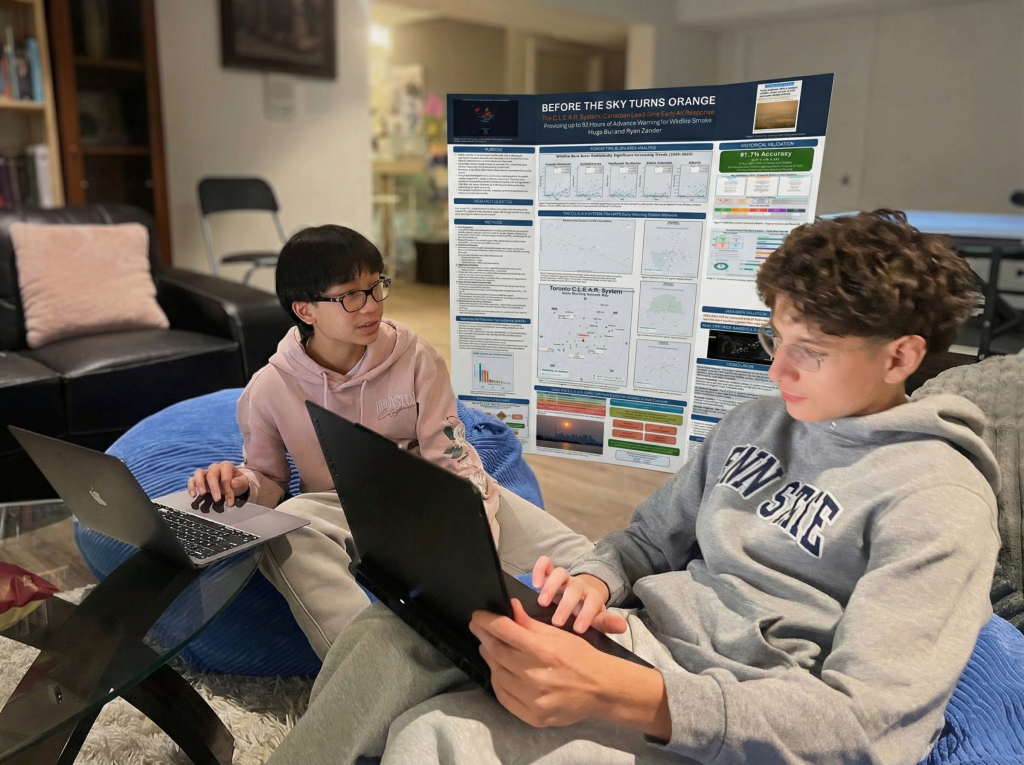
We have been working diligently on a live app version of the system. Here is the link to a beta version.
We also plan to use our funding from the UTS Lundy & Looker Climate & Environment Solution Fund to make our app more robust and to move Ryan’s Python script onto a live web server so we can deploy physical warning displays.
Our main focus now is to get C.L.E.A.R. live and operational in school lobbies before the wildfire season hits.