
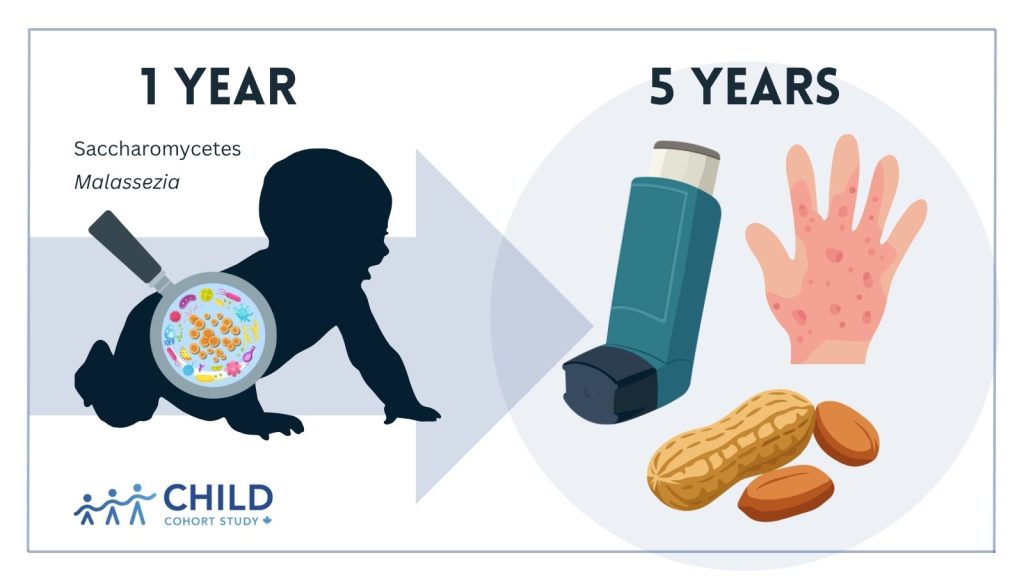
Two new studies headed by CHILD researchers reveal that certain species of fungi living in the human gut play a key role in the development of the immune system and some pediatric allergic diseases, suggesting these fungi may be promising targets for new treatments and preventative strategies. The two papers were jointly published in Nature Communications.
One paper, by CHILD Co-Director Dr. Stuart Turvey and his colleagues at BC Children’s Hospital Research Institute (BCCHR), analyzed CHILD data to demonstrate that fungi are indicators of early-life microbial development and of a child’s risk of developing diseases such as eczema and food allergy by age five.
Another paper, by CHILD researcher Dr. Marie-Claire Arrieta and her colleagues in the University of Calgary, found that infant exposure to antibiotics may directly impact certain yeast species living in the infant gut, leading to the development of immune dysregulation and allergic asthma.
The two articles together emphasize the importance of fungus in the gut microenvironment. The bacterial environment in the gut, known as the microbiome, has been relatively well studied, with recent discoveries in this field—including many by CHILD researchers—having led to potential new treatments. By comparison, very little research has been done on the fungal inhabitants of the gut— the mycobiome—and their role in health and disease.
“Hundreds of millions of children worldwide are affected by allergic disease, and the number is growing,” comments Dr. Turvey. “A better understanding of what gives rise to these conditions and how we can prevent them would have an enormous benefit for children around the globe.”
Dr. Turvey’s paper identifies a pattern in thousands of Canadian children. It analyzes 2,256 samples from 1,409 CHILD participants in their first year of life and shows that the infant mycobiome develops along highly predictable trajectories, with fungi such as Saccharomyces and Malassezia emerging as powerful markers of gut maturation, associated with the later development of eczema and food allergy.
Alongside it, Dr. Arrieta’s paper helps explain why this pattern might matter. It provides an elegant mechanistic complement, demonstrating that antibiotic-induced expansion of Malassezia can drive early-life immune dysregulation and airway inflammation in translational mouse models.
“Together, these studies make a compelling case that fungi are active participants in early immune development and deserve a central place in the next generation of microbiome research,” observes Dr. Courtney Hoskinson, lead author on Dr. Turvey’s paper.
“I also think these papers showcase a distinctly Canadian way of doing science: building long-term cohorts, sharing ideas across institutions, integrating human and experimental studies, and investing in trainees who go on to ask questions none of us would have thought to ask a decade ago,” adds Dr. Turvey.
“It’s a privilege to be part of a community, including all the generous families participating in CHILD, that continues to redefine how we think about microbes, immunity, and child health.”