
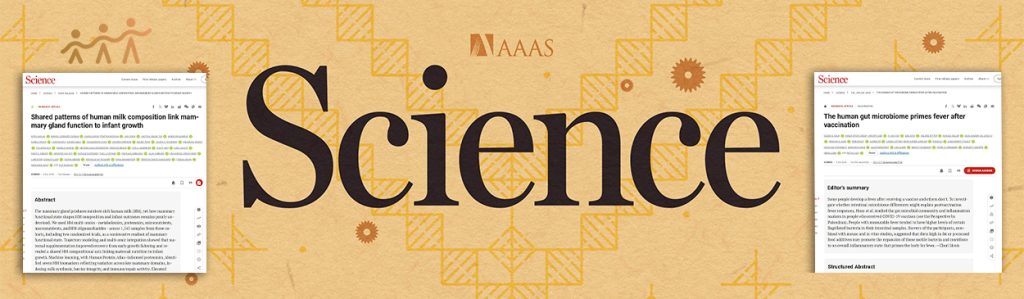
Not one, but two research papers using CHILD data were published simultaneously in the 8 October 2026 issue of the premiere journal Science.
Science is a leading weekly, international general science journal published by the American Association for the Advancement of Science (AAAS), founded in 1880 with initial support from Thomas Edison. With an exceptionally high impact factor* score of 45.8, it is among the top-tier global heavyweights of scientific publishing.
“It’s remarkable to have CHILD contribute to two Science papers on the same day, ” comments CHILD Deputy Director Dr. Charisse Petersen.
“Both papers depended on international collaboration and show how working across large cohorts strengthens our scientific findings. These papers highlight the fact that CHILD researchers are active members of a global network, and that CHILD data is helping to empower world-class research.”
* Impact factor is a measurement of the yearly average number of citations received by articles in an academic journal; any journal with a score above 15 is generally rated as “excellent.” A citation in scientific literature is a standardized reference to a previously published source that acknowledges the origin of specific data, ideas, methods, or direct quotes. A high citation rate is usually a reflection of the source’s importance or foundational influence (i.e., that it introduced a key theory, framework, dataset, or discovery that an entire subfield builds upon).
Maternal nutrition, breastmilk composition & infant growth
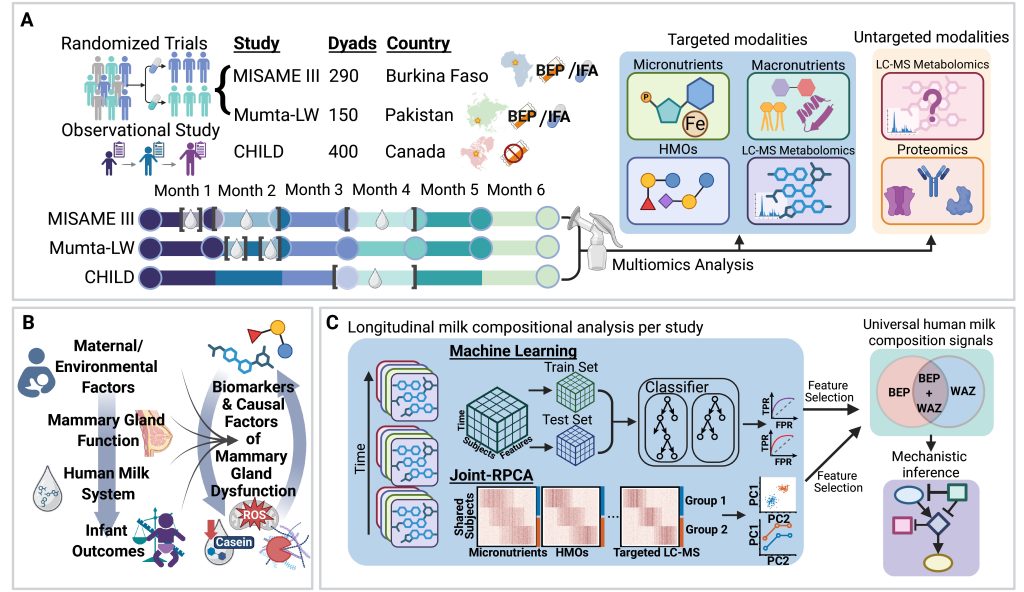
One of the papers examines how a mother’s nutrition impacts the composition of her breastmilk, and how this, in turn, relates to the growth of her infant.
For this study, the researchers used multi-omics data—specifically, data from metabolomic, proteomic, micronutrient, macronutrient, and human milk oligosaccharide analyses—from 1,543 milk samples collected across three cohorts, including CHILD. The three cohorts are all part of the International Milk Composition Consortium (IMiC), a global scientific research collaboration established in 2019 to perform a harmonized analysis of human breast milk across diverse low-, middle-, and high-resource settings.
CHILD provided an important point of comparison, representing a generally healthy population in a high-income country, while the other cohorts included mothers and infants in lower-income settings in Burkina Faso and Pakistan, where undernutrition is more common. This allowed researchers to study how milk composition varies across different nutritional and environmental conditions.
The researchers identified links between maternal nutrition, mammary gland metabolism, breastmilk composition, and infant growth. Their findings suggest that improving maternal nutrition could help support healthy milk production and infant development.
“We identified certain biomarkers—short-chain acylcarnitines, pantothenic acid, and related metabolic markers—that provide clues about how a mother’s nutritional and metabolic health influences her breastmilk,” explains co-author Dr. Meghan Azad, a CHILD researcher and Director of IMiC. “These findings could help us develop targeted nutritional strategies to support mothers and babies, particularly in settings where undernutrition is common.”
“Ultimately, our goal is to support maternal health and help ensure babies receive the nutrients they need to grow and thrive, wherever they live.”
Gut microbes may help explain fever after vaccination
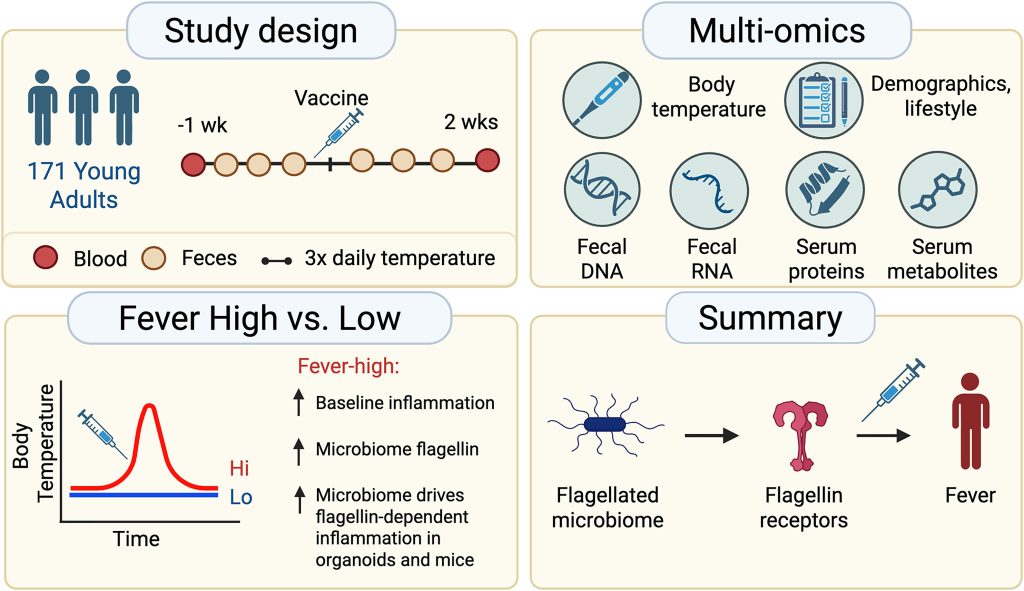
The second paper, led by Dr. Kelsey Huus and Dr. Ruth Ley’s research team at the Max Planck Institute in Germany, investigated why some people develop a fever after vaccination while others do not, focusing on COVID-19 vaccines.
The researchers found that people who developed fevers tended to have higher levels of certain bacteria in their guts even before vaccination. These bacteria have whip-like structures called flagella that help them move and can also trigger immune responses. Additional experiments suggested that diet, including high-fat foods and certain processed food additives, may influence these bacteria and the body’s inflammatory response.
CHILD contributed an independent dataset from its COVID-19 Add-on Study to help validate the findings. The CHILD team joined the international collaboration during peer review, providing additional evidence to strengthen the original research.
The collaboration began when CHILD researcher and Deputy Director Dr. Charisse Petersen connected with lead author Dr. Kelsey Huus at a Canadian microbiome research conference and recognized an opportunity to test the findings using CHILD data.
“Independent replication is a crucial part of good science, and we’re pleased that CHILD could contribute to this important discovery,” says co-author Dr. Meghan Azad, who led CHILD’s COVID-19 Add-on Study. “It’s a great example of the lasting value of research cohorts like CHILD, and of the unexpected collaborations that can emerge when scientists connect and share ideas.”
The findings suggest that the gut microbiome may help explain why people respond differently to vaccines and could eventually inform strategies to reduce vaccine side effects. They also highlight the broader connections between gut microbes and immune responses throughout the body.
Volunteer families empowering global research
“Two studies published in Science on the same day on two very different topics, with global connections and scope: what an impressive confirmation of the CHILD as a unique, invaluable source of data,” adds CHILD Director Dr. Padmaja Subbarao.
“My research colleagues and I hope the wonderful families participating in CHILD feel a great sense of well-deserved pride at what their generosity is enabling. Now, as we embark on the collection of 16-year data, we are again counting on them as the driving force behind more scientific discoveries like these. Thank you again, CHILD families!”